
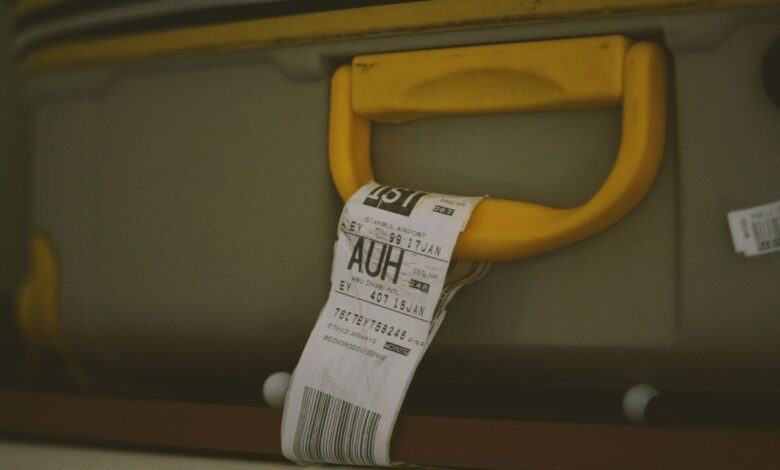
Trip length is the worst way to settle the carry-on vs checked bag question. What actually moves the outcome is the connection you booked and the fare you bought. A bag has to survive a transfer between two aircraft, and a ticket either includes that bag or charges you for it — and those two facts shift the answer far more than whether you are away for five days or fifteen.
Both strategies have a failure mode, and they are not symmetrical ones. Carry-on only can be overruled at the gate by a scale, a sizer, or a full overhead bin, and then you pay to check the bag anyway, at the worst possible moment. A checked bag is rarely lost for good; far more often it is separated from you at a transfer and turns the first day of the trip into a shopping errand. Start with time, because the clock that matters runs from your front door, not the gate.
How Carry-On and Checked Bags Change Your Door-to-Door Travel Time
Carry-on only does save time, and almost all of the saving sits in one interval: the stretch between reaching the arrivals hall and walking out of it. What makes that interval hard to plan around is that it is not a fixed number — on some arrivals you stand at the belt for half an hour or more, on others the bag is already circling when you get there. Every rule and figure below was checked on 20 September 2026, and airlines and national authorities can change any of them, so confirm your own route and fare on the operating airline’s own baggage page before you book.
Security, boarding and the flight itself run at much the same speed whichever you choose. The swing comes from a mismatch that has been widening at both ends of the arrivals hall. Departure baggage has been heavily automated for decades; arrivals baggage largely has not. BEUMER Group, which builds baggage-handling systems for airports, describes inbound bags at most airports as still being unloaded and sorted by hand onto the reclaim carousels — a manual process the company calls the industry standard for more than 30 years, and one it estimates roughly 90 percent of airports still use.
Your side of the hall, meanwhile, has got faster. A 2026 study in the Journal of Air Transport Management notes that automated e-gates at immigration can put passengers into the reclaim hall more quickly, which exposes the limits of an arrivals process that has barely changed, and that how closely passenger arrivals track bag arrivals has a material effect on how long people end up waiting.
So the wait has a shape you can predict: it is the bag’s delivery time minus your own clearance time. Sail through passport control and you inherit the whole delay. Get stuck in a long queue and the bag quietly catches up with you.
Two arrivals from the same autumn 2024 discussion on the Rick Steves travel forum show both ends of that range. One traveller landing in London wrote that after immigration and a stop at the bathroom her luggage was already coming onto the carousel — “It didn’t delay me at all.” Another, arriving at Amsterdam, reported that bags plus immigration together took most of an hour.
The departure side has its own arithmetic, and carry-on does not always win it. Bag drop can be a queue in its own right; a traveller in that same thread described waiting 45 minutes to check a bag with EasyJet. A rollaboard extracts its own toll, too, and it is charged precisely where you most want to move quickly. That is why experienced flyers often give the opposite advice to the instinct: asked about a one-hour transfer at Paris Charles de Gaulle, a Tripadvisor destination expert for air travel replied, “I would check the bag. You’ll walk/run faster without it.”
Price the time per itinerary, then, rather than per strategy. Flying non-stop to a city you are staying in for three days, the reclaim wait costs you minutes you were never going to use. Connecting through a hub, or landing with a train to catch, it can cost you the afternoon. That is the time side of the ledger, and the money side behaves differently, because the number is not attached to the bag at all.
What a Checked Bag Really Costs on International Fares
The fee is not a property of the bag. It is a property of the fare you bought, the route you are flying and the moment you pay — which is how two people on the same aircraft, with identical suitcases, end up paying nothing and eighty-five dollars.
American Airlines publishes that split openly. Its checked bag policy, consulted on 20 September 2026, lists transatlantic routes other than India and Qatar at no charge for the first bag — unless the ticket is Basic Economy, where the first bag is $85 for tickets issued on or after 18 May 2026.
On the same carrier’s South America routes the Basic Economy first bag is $70 while the Main Cabin fare still carries it free, and to Australia and New Zealand the page lists the first bag as free even on Basic Economy. Read down that table and the pattern is unmistakable: the airline is not pricing a suitcase, it is pricing a fare tier.
Which reframes the comparison. It is not bag fee against no bag fee; it is bag fee against the price gap to the next fare up, because the higher fare has the bag bundled inside it.
A traveller posting to the r/TravelHacks community in 2024 described the extreme version on a short domestic hop, where two checked bags would have run about $100: “Upgrading to first class only cost $30, and it included 2 checked bags for free.” That is one route on one day rather than a rule, but the mechanism behind it is general, and it is worth running on your own booking.
The two options are not equally good, and the cheap fare has a tail. Buying the low fare and paying the fee keeps the headline price down, but the fare family you bought comes with the rest of its terms attached — Delta publishes a $199 change or cancel fee on Delta Main Basic tickets from the United States to Europe, where its Classic tickets from the US carry none. Buying up usually solves the bag and the change fee together, but it is money committed whether or not you end up checking anything, and on some routes the gap is wider than the bag.
Which airline’s baggage rules apply to a two-airline ticket?
Here is the variable almost no comparison mentions, and it bites hardest on exactly the itineraries covered here. On a journey to, from or across the United States, one carrier’s baggage rules govern the entire trip rather than each carrier’s rules governing its own leg.
Lufthansa’s own fees page sets out the mechanism and names the US Department of Transportation consumer rule behind it: the rules of the airline listed first on the ticket usually apply, but that airline may transfer the role to another carrier in the itinerary — the “most significant carrier” — and Lufthansa states that it therefore cannot guarantee its own baggage rules will apply to a Lufthansa-issued ticket in every case.
Read that from your own seat and the consequence is uncomfortable. You can check one airline’s allowance, book with that airline, and fly the whole trip under a different airline’s allowance. On any two-airline ticket, the number that matters is the governing carrier’s, and your booking confirmation is where it is spelled out.
Where you pay moves the figure a little more: American discounts the first and second checked bags by $5 when they are paid on its website or app rather than at the airport, across the regions its fee table covers.
Who you pay matters more than that. Delta’s baggage page states that it does not sell baggage in advance through third parties, including travel agencies, and that any third party charging for a Delta checked bag is not authorised to do so. This site is published by a travel agency that sells flights, so take the following as an interested party pointing at the unflattering answer: buy the bag from the airline that will carry it, not from whoever sold you the ticket, and that includes us.
Before you pay for anything, open the operating airline’s baggage page for your exact route and fare name and read three lines: whether the first bag is included in that fare, what it costs if it is not, and whether the page quotes a different price online and at the airport. Put that number next to the fare difference and the decision usually makes itself. What the fee does not buy is any assurance that the bag arrives when you do — and that risk is concentrated in one place.
Why Tight Connections Are Where Checked Bags Fail Most
Transfers are where bags go wrong, and the industry’s own data says so plainly. SITA, which runs the baggage tracing system used across hundreds of airports, reports in its 2026 Baggage IT Insights that transfers caused 39 percent of mishandling in 2025, and attributes the concentration to connecting journeys involving more handlers, more systems and tighter connection windows. It also puts the shape of the risk in proportion: delayed bags dominate the volume, while genuinely lost bags are rare and expensive.
The US Department of Transportation ranks the same risk without a single statistic, in its own baggage guidance, and the ordering is worth memorising because it maps directly onto how you book.
Least likely to go astray is a nonstop. Then a direct or through flight with a stop but no change of aircraft. Then an online connection, where you change aircraft but not airline. Most likely of all is an interline connection, where you change both aircraft and airline. Every step down that list adds a handoff, and every handoff is somewhere a tag can be misread or a container can miss a cut-off.
That is why the number printed on your booking is so misleading. The minimum connection time is not a safety margin — it is a floor, and a floor built by the people who sell the connection. IATA defines the Station Standard MCT as “the Standard Airport official shortest time interval required to transfer a passenger and their luggage from one flight to a connecting flight in a specific location,” and says the value for each airport is calculated, agreed and submitted by the local minimum connecting times group or airline operating committee.
Two things follow, and together they explain most short-connection disasters. IATA states the interval is based on the scheduled time of passenger arrival and the scheduled departure of the connecting flight, so the buffer is measured against the timetable, not against the aircraft you are actually sitting on. A twenty-minute late arrival does not shorten a comfortable connection; it eats twenty minutes out of a window that was already the shortest the airlines were prepared to sell. And because IATA publishes the data as a paid subscription product, you cannot look up the figure that was applied to your booking, which means there is no check available to you — only a buffer you either built or did not.
Separate tickets remove the protection altogether, and the operators say so in their own terms. American’s baggage policy states that it only through-checks bags when all the tickets are in the same reservation and the onward flight is American or a oneworld partner. Two bookings that merely meet in the same airport are two contracts, so the bag is tagged to the end of the first one, and collecting it, clearing customs and checking it in again is your job, on your clock, with no one obliged to rebook you if the first flight runs late.
What actually works is unglamorous. Treat the published connection as the airlines’ floor and add your own margin on top of it, widen that margin when the transfer is interline or involves changing terminals, and assume nothing about a bag moving between two separate bookings.
The one piece of good news is that a transfer is rarely a black box any more: the traveller on the Rick Steves forum who flew Bologna to Washington via Munich on an 85-minute connection could see in the airline’s app that her bag had been loaded before she even reached her departure gate. None of that helps if the bag stays behind, though — and there are items that cannot ride in the hold at all.
What You Must Pack in a Carry-On vs a Checked Bag by Rule, Not Preference
Most guides answer what to pack in a carry-on vs a checked bag as a matter of taste. A good part of it is not. Two categories of rule assign items to one bag or the other before preference gets a vote, and they run in opposite directions — which is exactly why carry-on-only and check-everything both fail as absolute strategies.
Security rules push things out of the cabin. The TSA liquids rule, for screening at US airports, allows a quart-sized bag of liquids, aerosols, gels, creams and pastes in carry-on, limited to containers of 3.4 ounces or 100 millilitres or less, and directs that anything in a larger container is packed in checked baggage. Note what the limit actually measures: the container, not how much is left in it. A half-empty 200 ml bottle is over the limit at the checkpoint, which is the single most common way a carry-on-only traveller loses something at security.
Safety rules push in the other direction, and they are absolute. TSA’s power banks page records portable chargers and power banks containing lithium-ion batteries as carry-on yes, checked no, and states that spare lithium batteries — power banks and phone chargers among them — are prohibited in checked luggage. This one is not a preference you can trade away for space: if you pack the battery in the hold, the rule has been broken whether anyone notices or not.
Then there is the category the rules do not name but the compensation regime does. Anything whose replacement you could not absorb — medication, documents, keys, the camera, the laptop — belongs in the cabin, because the liability system underneath a checked bag pays out against a capped schedule and not against what the contents meant to you. The DOT’s own baggage guidance makes the same recommendation in its packing tips, and it extends it to a bag that could be checked at the gate for lack of bin space, which is a case most travellers never plan for.
Both exemptions that travellers ask about are narrower than the folklore. TSA lists medications and infant and child nourishments as exempt from the liquids limit. Duty-free liquids over 100 ml may ride in the cabin on an inbound international connection to the United States only if they are sealed by the retailer in a transparent, tamper-evident bag, show no sign of tampering, and are accompanied by the original receipt for a purchase made within the previous 48 hours — and TSA still recommends putting them in checked baggage instead. Anything over 100 ml that is not in such a bag goes in the hold.
The practical shape of this is a floor and a ceiling, not a strategy. Batteries, medication, valuables and documents establish a minimum cabin bag that exists even if you check everything else. Liquids over 100 ml, and anything sharp enough to be refused at a checkpoint, establish a minimum checked bag if you are carrying them at all. Work out those two minimums first, because they decide whether either pure strategy is available to you before any question of convenience arises. And if the answer is that carry-on-only is still on the table, there is one more gate to clear.
When Carry-On Only Fails: Weight Limits, Sizers, and Full Overhead Bins
A carry-on that is legal on the first leg of your itinerary is not automatically legal on the second, and this is where carry-on-only travellers from markets that rarely weigh cabin bags get caught. Lufthansa’s carry-on rules, read on 20 September 2026, set a long-haul Economy allowance of one personal item up to 40 x 30 x 15 cm plus one cabin bag up to 8 kg and 55 x 40 x 23 cm — and the carrier states plainly that it checks the amount, weight and dimensions of carry-on baggage at the airport. On its short and medium-haul Economy Basic fare, the allowance is the personal item alone. No trolley.
The airline also prices the failure, which is the part worth knowing before you gamble on it. Lufthansa’s page says non-compliant carry-on baggage is taken at the check-in counter or at the gate and carried in the hold at your expense, that the fees are significantly higher than for checked baggage booked in advance, that they can only be paid by credit card, and that they range from EUR 60 to EUR 110, or USD 75 to USD 125, depending on the route. Set that against a checked-bag fee bought in advance and the arithmetic of “I’ll risk it” changes considerably.
Compliance is not even sufficient. The same page states that on high-occupancy flights some compliant carry-on baggage must also go into the hold because the cabin has run out of storage, and that on fully booked flights operated by smaller aircraft larger cabin bags may have to be checked. This is the part that makes carry-on-only a probability rather than a plan: a correctly sized, correctly weighed bag can still be taken from you at the door because the aircraft filled up in front of you.
Two more details decide more cases than the headline numbers do. Lufthansa notes that any piece of baggage brought to the gate counts as carry-on baggage even when you have a checked allowance — so the duty-free bag and the airport sandwich are inside the limit, not outside it. And for multi-airline itineraries the carrier’s own instruction is to check the rules of each operating airline and follow the most restrictive of them, which is the only sensible way to pack a trip where one leg allows a trolley and another does not.
So run the audit before you commit rather than at the gate. Weigh the packed bag at home against the strictest limit on any leg you are flying, measure it with the wheels and handle included because that is how a sizer measures it, and price what an involuntary gate-check would cost on the carrier that would impose it. If any of those three answers is uncomfortable, you are not a carry-on-only traveller on this particular itinerary, whatever you are on others. Readers whose whole decision turns on cabin enforcement will want a leg-by-leg comparison of international carry-on size and weight limits, which is its own piece of work and a companion to this one.
One last thing the same page is right about: if a cabin bag does get taken at the gate, take out the valuables, the medication you need on the journey and every battery-powered device, power banks included, before it goes. That is the lithium rule from the previous section arriving in its most awkward possible form — in a queue, with a line behind you. Which leaves the question of what actually happens when a checked bag and its owner are separated.
What Happens If Your Checked Bag Is Delayed, Lost, or Damaged
The compensation you are owed is capped, and the cap is lower than most travellers assume. The US Department of Transportation sets the maximum liability on domestic US flights at $4,700 per passenger, and for most international flights the Montreal Convention limit applies at 1,519 Special Drawing Rights, which the DOT put at approximately $2,175 per passenger when its page was last updated on 29 October 2025. Airlines may choose to pay more; nothing requires them to. The international figure is reviewed for inflation every five years by ICAO, so it is a number worth rechecking rather than remembering.
Those two ceilings are the whole reason the previous section told you to keep valuables in the cabin. A capped schedule does not care what the contents were worth to you, and the cap is per passenger rather than per bag.
Delay is the far commoner outcome, and it is handled differently from loss. The DOT requires airlines to compensate passengers for reasonable, verifiable, actual incidental expenses while a bag is delayed, and specifically forbids them from setting an arbitrary daily amount — a carrier cannot publish a policy of reimbursing, say, fifty dollars a day. That is the rule that turns the essentials you bought on arrival into a claim rather than a loss, and it only works if you keep the receipts.
The timing is defined rather than discretionary, and knowing the thresholds is what gets a fee refunded. A bag counts as significantly delayed after 12 hours on a domestic US flight; on an international flight between a US and a foreign airport, after 15 hours where the flight is 12 hours or less, and after 30 hours where it is longer.
Cross that line and the bag fee you paid is refundable — but only if a mishandled baggage report is already on file, which is why the report gets made at the airport rather than the next morning. Airlines declare a bag lost on their own schedules, most commonly somewhere between five and fourteen days, and a lost bag’s fee must be refunded as well.
The gap between the rule and the experience is where expectations should sit. A traveller in the same Rick Steves discussion described a relative’s bag taking 38 days to come back, sitting in Dallas for much of it while the airline was told exactly where it was. That is one account and not a frequency, and the rules above are what the carrier owed throughout — which is the honest summary of this whole section. The entitlement is real, it is bounded, and it is slower than your holiday. Everything so far has been about constraints; the remaining question is what to do with them.
Which Bag Strategy Fits Your Itinerary: A Decision Matrix
By now the decision has stopped being a matter of temperament. Six things have to line up: how much time the reclaim gap actually costs on your route, what your fare charges for the bag, how many handoffs the itinerary contains, what the rules force into each bag, whether your cabin bag survives the strictest leg, and how much of the downside the liability cap leaves with you.
The matrix below reads those inputs against the trip profiles that recur most. It is a practical tool built for this guide from the four variables the sections above establish — connection structure, fare inclusion, cabin enforcement on the strictest leg, and how much moving around the trip involves — and not an industry standard.
| Itinerary profile | Strategy that fits | Why, and what it costs you |
|---|---|---|
| Nonstop, fare includes the bag, one hotel | Check the bag | No transfer to fail and no fee to avoid; you trade a reclaim wait you can absorb |
| Interline connection under about two hours | Hybrid: check, with a full cabin kit | The handoff is the weak point; the cabin kit makes a delay survivable rather than trip-ending |
| Separate tickets meeting at a hub | Carry-on only if the rules allow it | No through-check and no protection, so a hold bag means reclaim, customs and a fresh check-in |
| Multi-city trip with trains, stairs or frequent moves | Carry-on only, or one small checked bag | Mobility is the binding constraint here, not fees or transfer risk |
| Basic Economy long-haul, one destination, 10+ days | Compare buy-up against the fee before choosing | The fare gap is often smaller than the bag fee, and buys back the change terms too |
| Any leg on a carrier with an enforced cabin weight limit | Check the bag, or repack to the strictest limit | A gate-check penalty typically costs more than a bag booked in advance |
The row most travellers belong in is the second, and it deserves its name. The hybrid is not indecision — it is the only option that removes the largest downside on each side. Checking the bag removes the gate-check risk and the weight ceiling; a genuine cabin kit removes the “vacation starts with a shopping trip” outcome that makes a delayed bag feel like a lost one. Two travellers on the Rick Steves forum described the same refinement independently, packing half of each person’s clothes into each of the two bags, so that one bag arriving late leaves both people dressed.
What the matrix cannot do is override a rule. If your cabin bag is over the strictest limit on any leg, the carry-on rows are closed to you regardless of profile. If your fare excludes the bag and you have no intention of buying up, the fee is part of the trip cost rather than a decision. And if the itinerary is two separate tickets, the checked rows carry a risk no strategy removes.
So finish with two checks rather than one, because they happen at different moments. At booking, look up the fare’s baggage inclusion and the connection structure on the operating carrier’s site. While packing, weigh and measure the cabin bag against the strictest leg, and confirm that the batteries, medication and documents are in the bag that stays with you. Do those two and the decision is no longer a gamble on temperament.
A Decisão Final
The bag question is really two questions — whether your connection can carry a checked bag, and whether your fare already includes one — and both are answered on pages you can open before you pay. Do that one thing: pull up the operating airline’s own baggage page for your exact route and fare family, and read the cabin weight limit alongside the checked-bag fee. The travellers who skip it are the ones paying a gate-check penalty at boarding, or finding out at the counter that the cheap fare never included the suitcase. This site is published by a travel agency that sells flights, and the check still works better on the airline’s page than on ours.
Frequently asked questions
Do I need to collect and recheck my bag at my first stop in the United States?
Plan for it. The US Department of Transportation lists one exception to its bag-fee refund rule for a significantly delayed bag: where you failed to pick up and recheck the baggage at the first international entry point to the US. Leave time in the connection.
Are valuables in a checked bag covered if the airline loses them?
It depends on the itinerary. On US domestic flights, airlines may exclude categories such as electronics, cash and jewellery in their contract of carriage and owe you nothing for them. On international itineraries, the Department of Transportation says they are responsible for such items once accepted, up to the treaty limit.
Is a wheelchair or other assistive device covered by the same liability cap?
Not on US domestic flights. The Department of Transportation says assistive devices lost or damaged in domestic air travel are not subject to the baggage liability limit, and the airline is liable for the original purchase price. On international travel, the treaty limit applies.
